📐
DOM Geometry
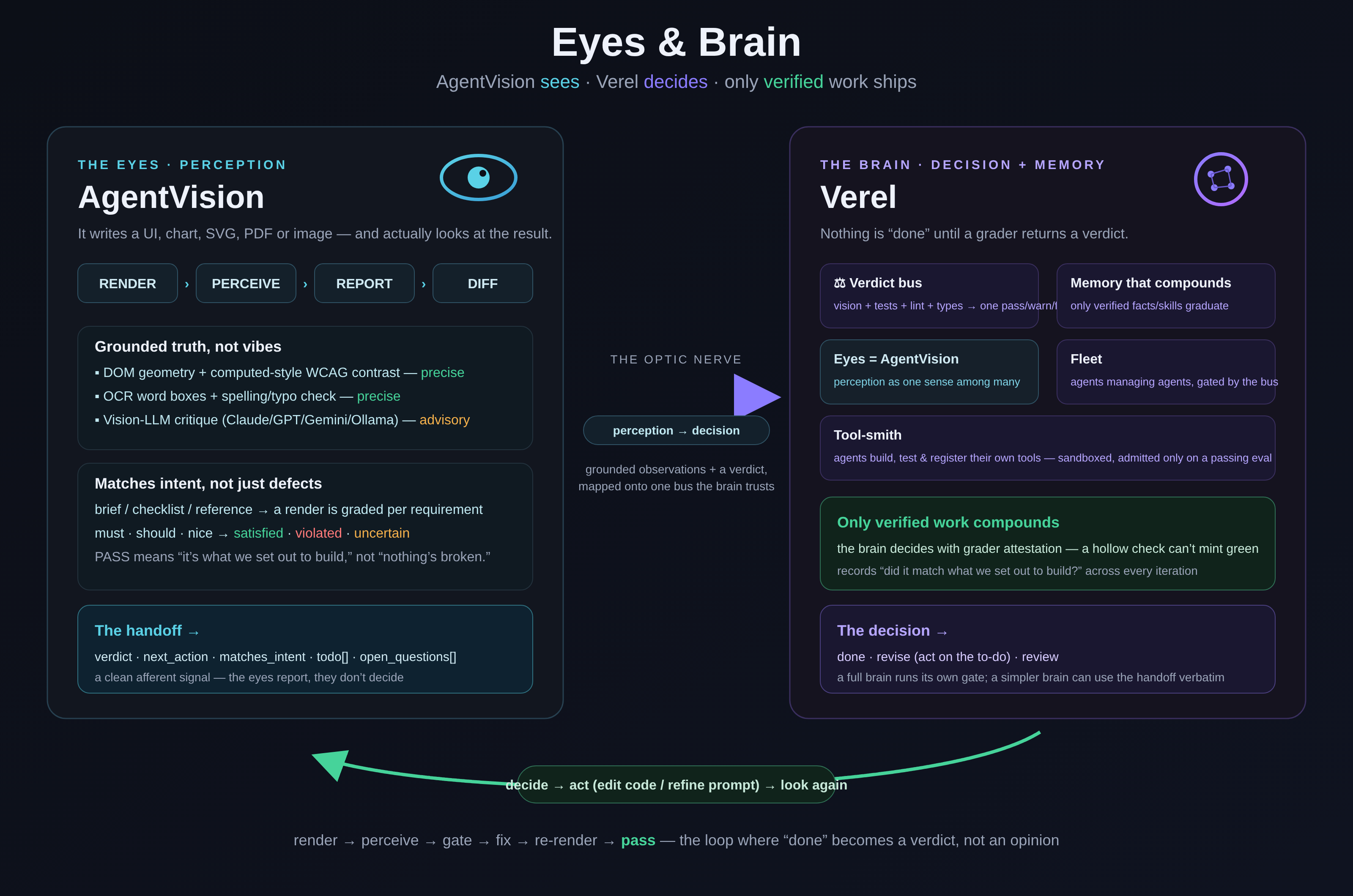
Precise element boxes via getBoundingClientRect + scroll offset. Coordinate-grounded overflow and clip detection.
🎨
Real WCAG Contrast
Ratios from getComputedStyle over solid backgrounds; over a canvas / raster map / gradient it grades from the rendered pixels (worst-case sampling) instead of guessing.
🔤
OCR Word Boxes
Tesseract-powered text locations for clipped labels, overflowing content, and garbled rendering.
🌐
Network & Console
Catches 4xx errors and console warnings — the #1 “looks fine in code, broken live” cause.
🤖
Vision LLM Critique
Claude / OpenAI / Gemini add semantic critique on top. Pixel boxes flagged bbox_precise:false.
📱
Responsive Sheets
Contact sheets across 375, 768, 1280, 1920 px breakpoints to surface layout bugs at every viewport.
📸
Visual Regression
Named baseline snapshots + diff scoring so agents know exactly what regressed between iterations.
🩺
Doctor Command
Runs a real Chromium launch, checks Tesseract, poppler, and every missing system dependency.
🔌
Provider-Agnostic API
Swap backends via --backend flag or env var. Uniform API surface across all vision providers.
🎞️
Temporal Verification
watch samples frames over time to verify playback, loading & liveness — is the video actually playing, did the spinner clear, are captions on. Deterministic <video> state + pixel liveness. Now grades local video files & animated GIFs too (a dead/static export FAILs). For streaming UIs & live dashboards.
🔐
Authenticated & Interactive
Render an app behind a login (--storage-state) and reach state behind a click — a closed-vocabulary --interactions list (click / hover / fill / canvas click_at) opens a popup before grading. Read-only by default; origin-scoped auth.
🖌️
Canvas-Baked Text
Text painted straight into a <canvas> (a chart label, a metric on a heat tile) has no DOM node to inspect — OCR + worst-case pixel contrast flags the unreadable ones at the chart/colormap layer.
🧩
Full-Coverage Vision
Large artifacts are tiled at full resolution (overview + detail), so no small text or chart data is lost to downscaling. Pixel-based & source-agnostic — HTML, images, PDFs, canvas alike.
🖥️
Live Desktop Sight
Point the eyes at the live desktop screen — agentvision screen, a desktop:/screen: source, or the capture_screen MCP tool. Capture is consent-prompted via the OS portal (freedesktop xdg-desktop-portal) and ephemeral, then grade is a dialog asking about X? on what the agent actually sees.